By HU Lan, WANG Jieling | Reviewed by HE Ying
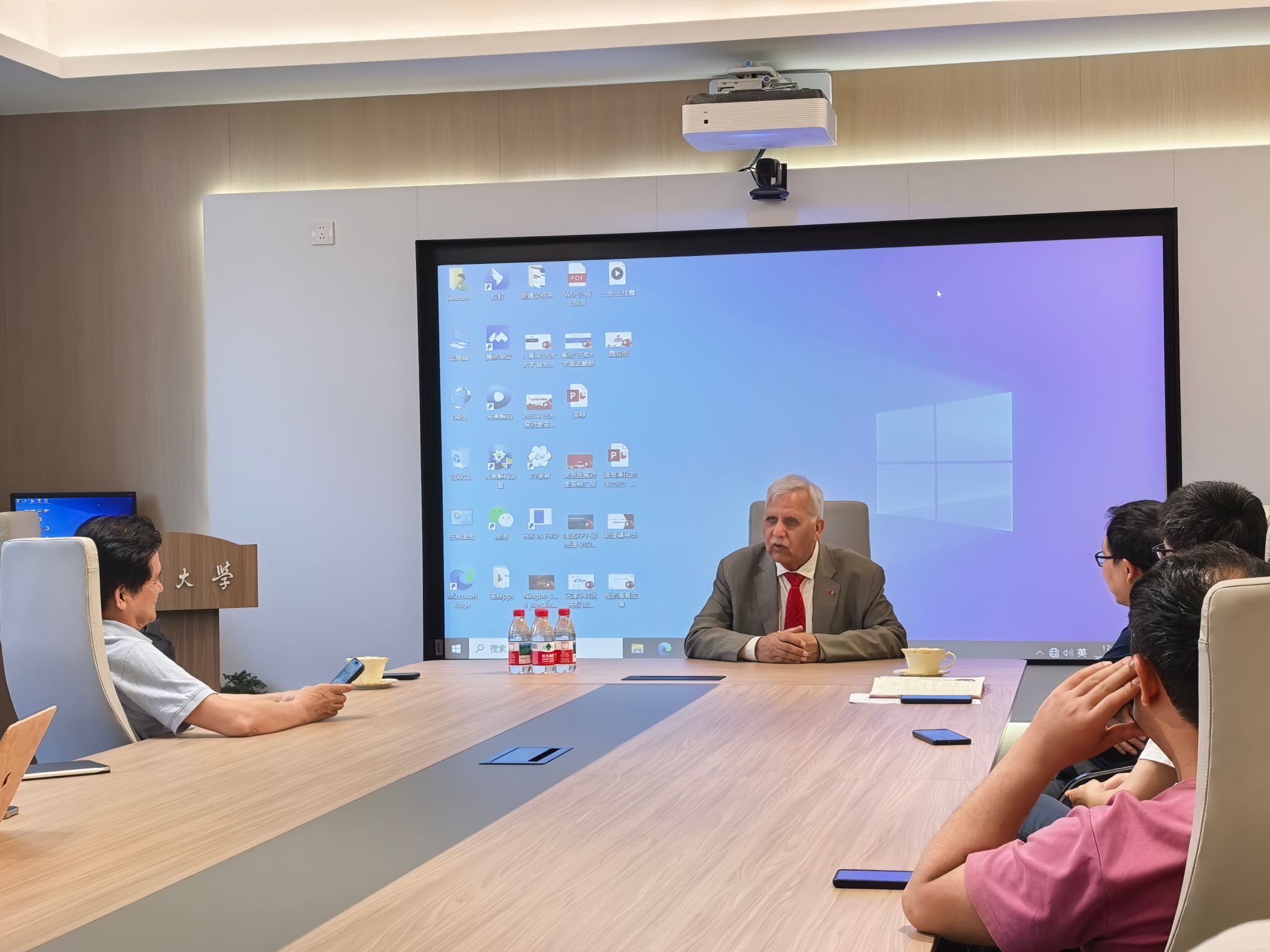

NINGBO, China — On the afternoon of May 18, 2026, a special lecture on“China-Pakistan Relations and Cooperation Opportunities”took place in Room 422 of the Li Dak Sum Foreign Languages Building at Ningbo University. The event was organized by the Zhejiang-Pakistan Joint Laboratory for Traditional Medicine Research and Development, co-hosted by the Institute of Drug Discovery Technology and the Faculty of Foreign Languages at Ningbo University. It also served as a key outcome of the Faculty’s ongoing international collaboration efforts led by its International Office and Discipline Development Office, further deepening academic and cultural exchanges between higher education institutions in China and Pakistan.
The lecture was chaired by Professor Zhang Zhi of the Faculty of Foreign Languages. The distinguished guest was Professor Zamir Ahmed Awan, Founding Chairman of the Global Silk Route Research Alliance, former Counsellor at the Embassy of Pakistan in China, and widely recognized as the“Ambassador of China-Pakistan Friendship.”Drawing on his extensive diplomatic experience and deep ties with China, Professor Awan offered a rich and nuanced account of the historical foundations and future potential of the bilateral relationship.
A Vision of Cooperation Spanning Civilizations and Borders
Professor Awan’s lecture drew on a remarkable range of experiences: his student years in China, his work in engineering practice, his role in science and technology policy formulation, and his decades of diplomatic service. From this wealth of firsthand knowledge, he examined the foundations and future potential of China-Pakistan cooperation across science, technology, education, and culture. He placed particular emphasis on the China-Pakistan Economic Corridor (CPEC) under the Belt and Road Initiative (BRI), sharing detailed outcomes in infrastructure development, energy collaboration, and livelihood improvement. Through vivid case studies, he brought to life the depth of the friendship between the two nations—from high-level government agreements to people-to-people exchanges at the grassroots level—allowing the audience to appreciate the authentic and deeply felt“Iron Brotherhood” between China and Pakistan.
Mutual Learning Among Civilizations: A New Path for South-South Cooperation
Perhaps most striking was Professor Awan’s framing of China-Pakistan cooperation not merely as an economic or technological partnership, but as the meeting of two ancient civilizations in the contemporary era. He pointed to a remarkable cultural resonance: the Confucian value of “harmony without uniformity” (和而不同)—the ideal of unity that respects and preserves diversity—finds a powerful echo in Islamic teachings such as“Seek knowledge even as far as China.” This cultural affinity, he argued, provides a solid foundation for deepening bilateral collaboration and for building a “community with a shared future for mankind.” In his view, the China-Pakistan model of cooperation offers a replicable framework for South-South collaboration—one rooted not only in shared interests but in shared values and mutual respect.
A Warm Reception and High Hopes for Continued International Dialogue
Professor Awan’s lecture—broad in vision, concrete in its examples, and profound in its insights—drew an enthusiastic response from the audience. Faculty and students raised questions on higher education cooperation, joint research and development ventures, and mechanisms for youth exchange. Professor Awan responded patiently and thoughtfully, creating a lively atmosphere of genuine intellectual exchange. Many students noted afterwards that the lecture had not only deepened their understanding of the history and future potential of China-Pakistan relations but also brought home the real-world significance of civilizational dialogue under the Belt and Road Initiative—and strengthened their own motivation to participate in international exchanges.
The successful hosting of this lecture marked a further expansion of the Faculty of Foreign Languages’cooperation with experts from Belt and Road partner countries, underscoring the Faculty’s role as a bridge for cross-cultural and interdisciplinary international exchange.