By HU Lan, WANG Jieling | Reviewed by HE Ying
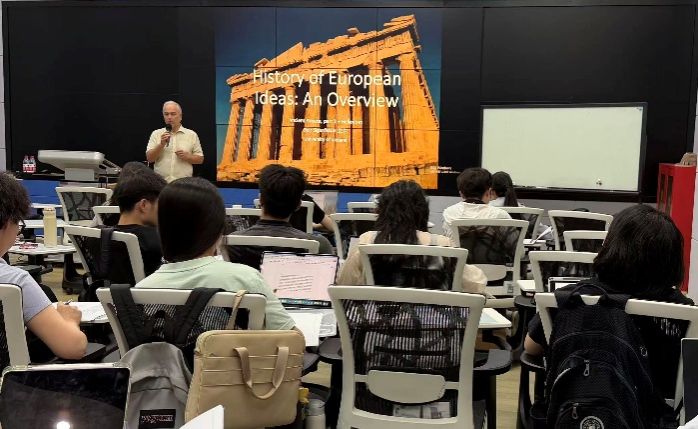
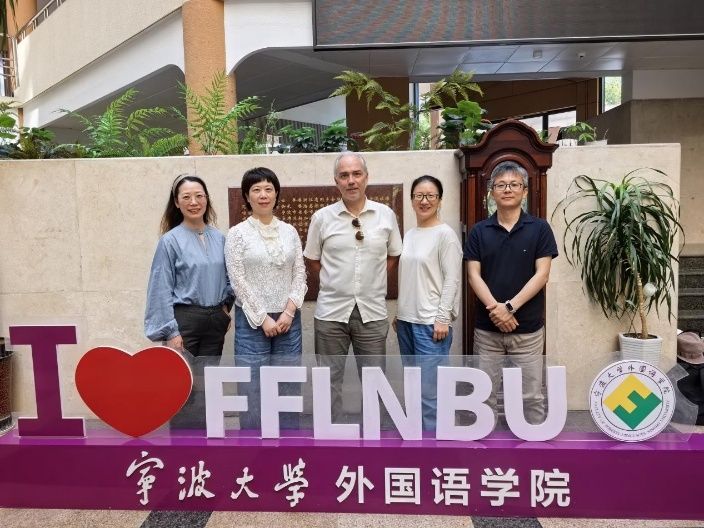
NINGBO, China — In mid-May 2026, the Faculty of Foreign Languages at Ningbo University hosted the inaugural “International Expert Short-Term Visiting Lecture Series” under the theme of Cross-Cultural Studies. The series featured Professor Geir Sigurðsson, a renowned scholar in Sinology and cross-cultural philosophy from the University of Iceland and Chair of the European Association for Chinese Philosophy (EACP). Over six lectures delivered between May 11 and May 18, Professor Sigurðsson engaged faculty and students on topics ranging from ancient Greek philosophy and modern European thought to cross-cultural comparative studies, offering an immersive academic experience that enriched international academic perspectives and deepened cross-cultural understanding.
The Visiting Lecture Series was jointly organized by the Faculty’s International Office and Discipline Development Office. Designed to bring world-class scholars to campus for intensive, short-term teaching engagements, the initiative aims to build a platform for cross-cultural academic exchange, promote interdisciplinary synergy, and facilitate mutual learning among civilizations—all while enhancing the Faculty’s global engagement and academic excellence.
Tracing the Arc of Western Philosophy
From May 11 to May 14, Professor Sigurðsson delivered four consecutive lectures tracing the trajectory of Western philosophy from antiquity to modernity. Using the concept of “modernity” as his guiding thread, he systematically examined the evolution of philosophical thought from ancient Greece to contemporary Europe, addressing foundational theories and enduring questions such as the origins of reason, the transformation of subjectivity, and the legacy of the Enlightenment. The lectures were chaired, respectively, by Professor Zhang Zhi, Dr. Zhang Wenwen, Associate Professor Wang Yili, and Dr. Li Jing. Throughout the sessions, students and faculty engaged actively in discussion, exchanging ideas on the historical roots of Western thought and its relevance to philosophical inquiry today.
Iceland as a Micro-State: A Window into Small Countries’Global Roles
On May 15, Professor Sigurðsson shifted his focus from philosophy to geopolitics in a lecture titled “Iceland as a Micro-State.” Drawing on his extensive experience living and researching in Iceland, he offered a vivid portrait of the country’s unique geography, distinctive economic model, and nuanced positioning in international relations. Chaired by Professor Fu Rongbo, the lecture introduced students to the often-overlooked perspectives of micro-states in global affairs and sparked thoughtful discussion on how national size intersects with pathways to civilizational development, revealing both differences and commonalities across cultures.
Confucian Thought Meets a Global Challenge: Rethinking Aging in the West
The series concluded on May 18 with a cross-cultural tour de force: “Western Aging vs. Confucian Philosophy of Old Age.” Professor Sigurðsson placed the pressing demographic challenges facing modern Western societies in direct dialogue with the Confucian ethical tradition—especially the Mencian concept of “respecting the elders in one’s own family and extending that respect to the elderly of others” (老吾老以及人之老), a principle that advocates universal care for the aged as a natural extension of family ethics. He argued compellingly that the social care and intergenerational solidarity embedded in Confucian philosophy offer culturally grounded resources and practical insights for addressing global aging. The lecture was chaired by Associate Professor Huang Dawang. In a lively and intellectually generous exchange, faculty and students debated differences in elderly care models between China and the West, the role of family versus state policies in supporting the aged, and the ethical dimensions of aging societies.
Mutual Learning Among Civilizations: A Pathway to High-Quality Academic Development
The Visiting Lecture Series was warmly received by all who attended. Faculty and students alike noted that Professor Sigurðsson’s lectures balanced scholarly rigor with humanistic warmth—not only illuminating the core debates of Western and cross-cultural philosophy but also inspiring fresh thinking on the construction of a contemporary Chinese philosophical discourse and the concrete pathways toward genuine mutual learning among civilizations.
Looking ahead, the Faculty of Foreign Languages will continue to leverage the joint platform of its International Office and Discipline Development Office to invite more internationally renowned scholars for short-term visiting lectures. By sustaining an open, diverse, and inclusive academic environment, the Faculty aims to support high-quality disciplinary development and talent cultivation—contributing, in its own way, to the broader vision of civilizational dialogue and the building of a community with a shared future for mankind.